
South Asian Diet Portions
There are six standard exchange lists:
Carb: No Carb:
Starches/Grains Non-Starchy Vegetables
Fruits Meats
Milk Fats
For vegetarians, we have included Dal/Beans as a separate group. One exchange of Dal/Beans replaces 1 exchange of Meats and 1 exchange of Starches/Grains.
| Carbohydrate (grams) | Protein (grams) | Fat (grams) | Calories | ||
| Starch/Grains | 15 | 3 | Trace | 80 | |
| Vegetable | 5 | 2 | — | 25 | |
| Fruit | 15 | — | — | 60 | |
| Fat | — | — | 5 | 45 | |
| Milk | Skim Low fat Whole | 12 12 12 | 8 8 8 | trace 5 8 | 90 120 150 |
| Meat | Lean Medium fat High fat | — — — | 7 7 7 | 3 5 8 | 55 75 100 |
| Dal/beans (Meat Substitute) | 12 | 6 | 1 | 80 | |
Good nutrition is eating a wide variety of foods from each of the main food groups. Your meal plan is designed as a guide to help you meet your health needs.
Food, exercise, and medicine are all important ways to care for your health. Food contains three major nutrients: carbohydrate, protein, and fat. Of these, carbohydrates raise the blood glucose levels the most.
To control your blood sugar:
- Try to eat meals and snacks at the same time each day
- Avoid skipping meals
- Eat about every 4-5 hours
- Food weights and measure are taken after it has been cooked.
Exchange List Starch & Breads
This group includes grains and starchy vegetables. Consider choosing products which are whole grains with higher fiber value.
Sample Traditional Foods
| Aviyal: ½ cup |
| Chapati/Phulka/Sookhi roti: 1 – 6” |
| Corn, medium ear (Bhutta): 1- 6″-long |
| Couscous: 1/3 cup |
| Dalia: ½ cup |
| Dhansak: ½ cup |
| Dholka, square: 1” |
| Dosa, plain: 1 |
| Flour: 3 Tbsp |
| Granola, low fat: 1/4 cup |
| Grits: ½ cup |
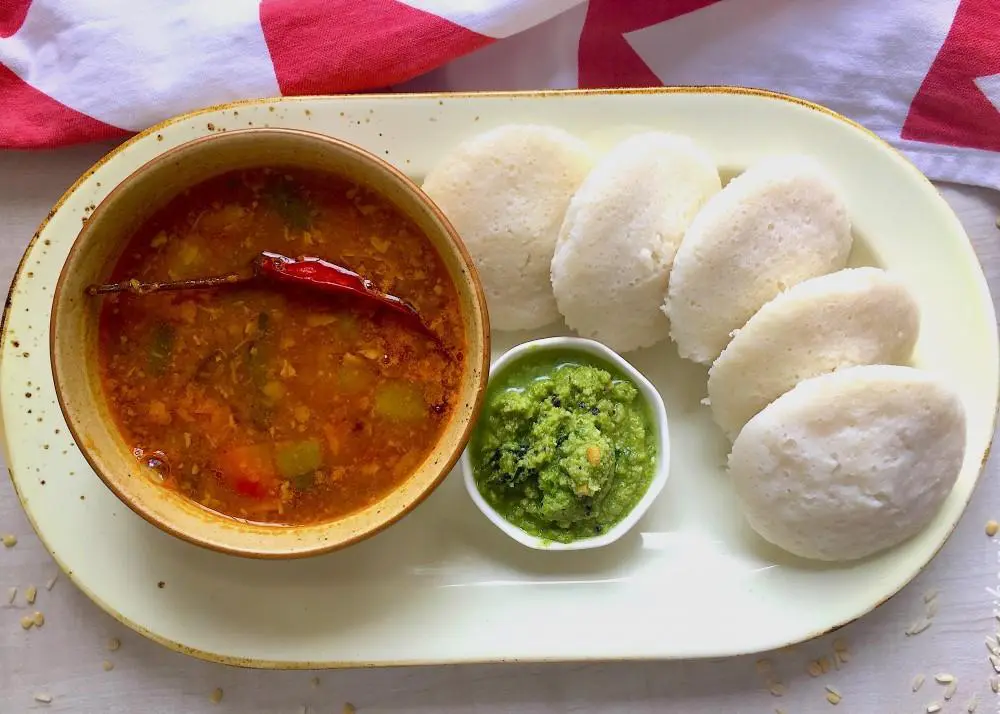
| Idli, plain: 3 inch round |
| Kasha: ½ cup |
| Matki usual: ½ cup |
| Millet 14/ cup |
| Muesli: ¼ cup |
| Mumra: 1 ½ cup |
| Naan: ¼ of 8”x2” |
| Oats: ½ cup |
| Paratha of Thepala: 1 – 6” |
| Pasta: 1/3 cup |
| Peas, green: ½ cup |
| Plaintain: 1/3 cup |
| Poato Subji, low fat: ½ cup |
| Poha: ½ cup |
| Pumpkin, winter: ¾ cup |
| Puries: 2 – 5” |
| Rice milk: ½ cup |
| Rice, plain, basmati, brown: 1/3 cup |
| Roti (bajra, corn, juwar): ½ – 6” |
| Sambar: ½ cup |
| Squash, winter: 1 cup |
| Upma: ½ cup |
| Wheat Germ: 3 Tbsp |
| Yam, Sweet Potato, plain: ½ cup |
Cooking Notes:
¼ Cup of uncooked pasta yields ½ cup Cooked Pasta
1 Cup of Atta (Wheat, Bajra, Jowar, Corn) Yields 5 Roti/Chapati
1/3 cup of batter yields one 10″ Dosa
¼ cup of batter yields one Idli
3 Tablespoon of rice yields 1/3 cup Rice
3 Tablespoon of cracked wheat, oats yield ½ cup serving
Exchange List Fruits
Sample Traditional Foods
| Amla (Gooseberry): 15 |
| Apricots, dried: 8 halves |
| Dates (Fresh): 3 |
| Figs (2″, raw): 2 |
| Guava (medium): 1 ½ |
| Jambu: 6 |
| Loquat: 4 |
| Mango: ½ or ½ cup |
| Papaya: 1 cup cubed |
| Passion fruit: ½ medium |
| Persimmon, medium: 2 |
| Sapota Chiku: 1 medium |
| Seetaphal (medium): ½ |
| Tangerines: 2 |
Exchange List Milk and Milk Substitutes
An exchange is one cup (8oz) of milk or 3/4 cup (6 oz) yogurt. For weight loss and lowering cholesterol, it should be low fat or skim milk. Avoid using sweetened or flavored varieties.
Sample Traditional Foods
| Buttermilk, Nonfat: 1 cup |
| Dry Milk, Nonfat or Regular: 1/3 cup |
| Evaporated Skim or Whole milk: ½ cup |
| Kefir: 1 cup |
| Lassi, Sugar Free: 1 cup |
| Masala Tea, with 1% milk: 1 cup |
| Milk, Skim, Low Fat, Chach: 1 cup |
| Paneer: 1% 1 oz |
| Yogurt, Nonfat, Plain: 3/4 cup |
Exchange List Dal Beans Pulses
This Group can be used as a substitute for meats and cheese. Each exchange contains both carbohydrate and protein. Each is counted as one exchange of ‘Starch/Grains’, and one exchange of ‘Meats/Proteins’. Portions are measured already cooked.
Sample Traditional Foods
| Azuki (Adzuki, Red Chori, Red Cowpea): ½ cup |
| Cowpeas (Lobiya, Chora, Black-Eyed Peas, Black-Eyed Beans): 1/2 Cups |
| Falafel: 3 patties (2” across) |
| Fava Bean (Field Beans, Broad Bean, Val): ½ cup |
| Garbanzo Beans (Chickpea, Chole, Chana, Bengal Gram): ½ cup |
| Horse Gram (Kulthi): ½ cup |
| Hummus: 1/3 cup |
| Kidney Beans (Rajma): ½ cup |
| Lima Beans: 2/3 cup |
| Masoor (Red Gram, Red Lentil): 1/2 Cup |
| Miso: 3 Tbsp |
| Moth Beans (Moath): ½ cup |
| Mung (Moong, Green Gram), Cooked: ½ cup |
| Peas (Split Peas, Matar, Vatana): ½ cup |
| Rasam: 1 cup |
| Tomato Dhal: ½ cup |
| Toor (Pigeon Peas) Dhal, Cooked: ½ cup |
| Toor (Pigeon Peas, Split Yellow Gram): 1/2 Cup |
| Urad (Black Gram): ½ cup |
Cooking notes
In general, ¾ cup of dried beans will yield 2 cups of cooked dense beans equaling 4 servings.
3 Tablespoon of beans (Cholay, Rajma, Urad) yields 1/3 cup Dense Dal
2 Tablespoon of lentils (Masoor) yields 1/3 cup Dense Dal
Exchange List Meats/Proteins
Meat and protein exchanges are listed in 1-ounce equivalents. A 3-ounce portion (deck of cards) equals 3 exchanges.
Sample Traditional Foods
Paneer, 1% milk: ¼ cup
Tandoori Chicken: 1 oz
Ground Meat Kabob: 1 oz
Oysters: 6
Sardines: 2
Egg: 1
Tempeh: ¼ cup
Tofu: 2oz
Exchange List Non-Starchy Vegetables
Non-starchy vegetables generally have fewer calories and carbohydrates. Portions are usually ½ cooked or 1 cup raw.
Sample Traditional Foods
Artichoke, hearts
Bamboo shoots
Bean Sprouts (Mung)
Beets (Chukandar)
Bottle Gourd (Lauki)
Cauliflower (Gobi)
Cluster Beans (Guvar)
Dill (Suva Bhaji)
Drumsticks (Surgavo)
Eggplant (Brinjal)
Fengugreek Leaves (Methi)
Karela (Bittermelon)
Kandkoda (Golkandra)
Kholrabi
Okra (Lady’s Fingers)
Parwar
Ridge Gourd (Torai or Turia)
Spinach (Palak)
Taro Leaves, Roots
Turnip
Water Chestnuts
Watercress
Zucchini
Exchange List Fats and Oils
Fats are found in nuts, cooking oils and cooking fats. The nuts also have some protein but should be considered here as a Fat Exchange
Sample Traditional Foods
| Unsaturated (preferred): |
| Almonds, cashews, Mixed Nuts: 6 each |
| Avocado, Medium (1 oz): 1/8th |
| Oil (Olive, Canola, Corn, Safflower): 1 tsp |
| Olives, Large: 8 |
| Peanuts: 10 |
| Pecans, Walnuts: 4 Halves |
| Seeds (Sesame, Pumpkin, Sunflower): 1 Tbsp |
| Tahini Paste: 2 tsp |
| Saturated (avoid): |
| Butter 1 tsp |
| Coconut Oil: 1 tsp |
| Coconut, Desiccated: 2 Tbsp |
| Ghee (Clarified Butter): 1 tsp |
| Hard Margarine: 1 tsp |
| Salt Pork: ¼ oz |
| Shortening (Vanaspati Ghee, Dalda): 1 tsp |
Adapted from:
www.indiacurry.com/diabetes/diabetesexchange.htm
https://dtuc.ucsf.edu/pdgs/FoodLists.pdf
Patel C, Denny M. Cultural foods and renal diets: a multilingual guide for renal patients,
Section II. Council on Renal Nutrition of Northern California. NKF. Second ed. 1997.